
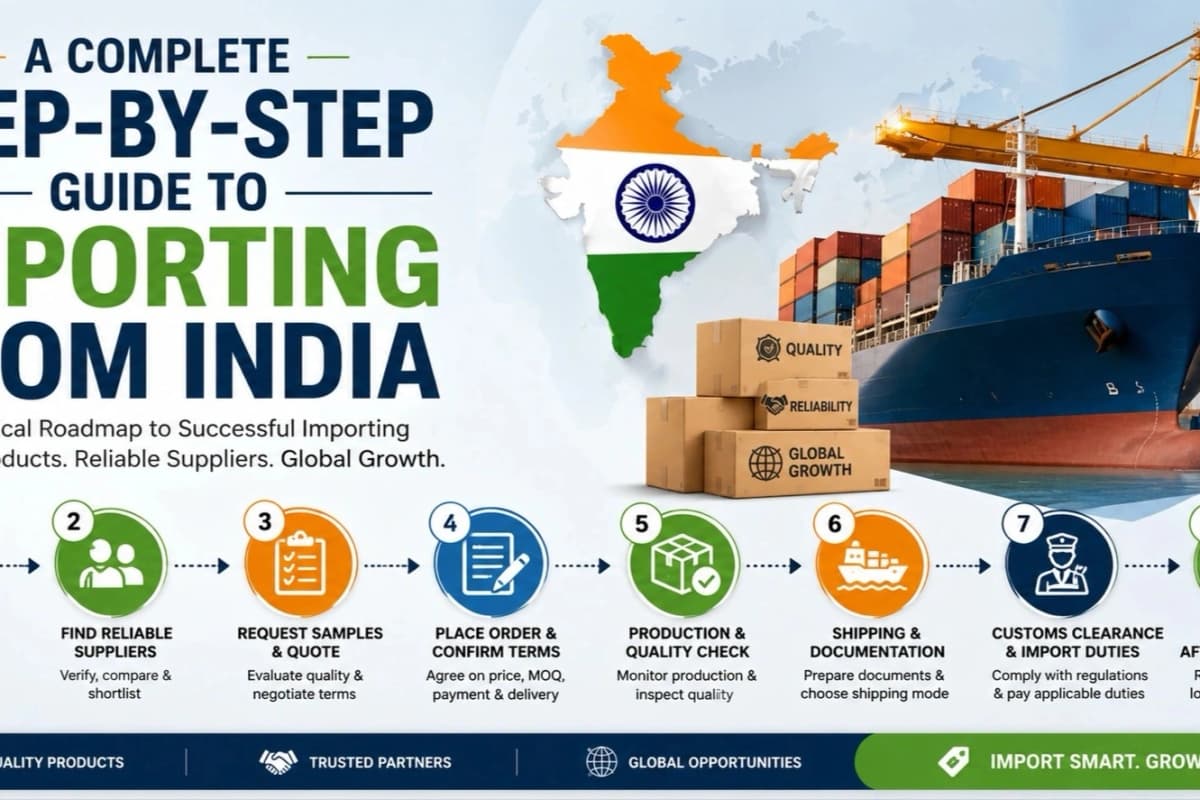
India has emerged as one of the world's most strategic sourcing destinations, supported by a mature manufacturing ecosystem, competitive production costs, a skilled workforce and robust export infrastructure. Today, buyers from North America, Europe, Australia, Middle-East and Africa source a diverse range of products from India—including textiles, Eco-friendly packaging, handicrafts, engineering goods, agricultural products and consumer merchandise.
However, successful importing requires more than identifying a supplier with competitive pricing. It demands a structured procurement strategy, comprehensive supplier due diligence, well-defined quality assurance protocols, compliance with international trade regulations and efficient logistics planning.
This guide outlines the technical stages involved in importing products from India, helping procurement professionals establish a reliable and scalable supply chain.
Step 1: Define Product Specifications and Procurement Requirements
The procurement process begins with developing a detailed Product Requirement Specification (PRS). Ambiguous requirements often result in production inconsistencies, increased lead times and higher rejection rates.
Your product specification document should include:
- Product description and intended application
- Material composition and grade
- Dimensions and tolerances
- Weight specifications
- Color standards (Pantone/RAL references where applicable)
- Construction details
- Printing or branding requirements
- Packaging specifications
- Labeling requirements
- Compliance standards applicable in the destination market
- Testing and certification requirements
For customized products, providing technical drawings, CAD files, artwork or reference samples significantly reduces manufacturing errors.
Step 2: Conduct Comprehensive Supplier Due Diligence
Supplier selection should extend beyond price comparisons. Evaluate manufacturers based on operational capability, export experience, quality systems, financial stability and production scalability.
Areas to assess include:
Manufacturing Capability
- Factory size
- Production capacity
- Machinery and automation
- Workforce strength
- Production flexibility
Export Experience
Determine whether the supplier regularly exports to your target market and understands destination-specific compliance requirements.
Certifications
Depending on your industry, verify certifications such as:
- ISO 9001 (Quality Management)
- ISO 14001 (Environmental Management)
- SA8000 (Social Accountability)
- SEDEX
- GOTS
- OEKO-TEX
- BSCI
- FSC (where applicable)
Business Verification
Review:
- IEC (Importer Exporter Code)
- GST registration
- Company incorporation documents
- Export history
- Customer references
A supplier audit—either on-site or through an independent third-party inspection agency—is recommended before initiating long-term procurement.
Step 3: Issue a Formal Request for Quotation (RFQ)
Professional procurement should always begin with a structured RFQ rather than a general price inquiry.
A complete RFQ should include:
- Product specifications
- Annual purchasing volume
- Initial order quantity
- Target pricing
- Packaging requirements
- Shipping destination
- Preferred Incoterms
- Required certifications
- Delivery schedule
- Payment expectations
A detailed RFQ enables suppliers to prepare accurate commercial proposals and reduces negotiation cycles.
Step 4: Evaluate Commercial Quotations Beyond Unit Cost
Procurement decisions should be based on Total Landed Cost (TLC), not simply the quoted factory price.
Evaluate the following cost components:
- Unit manufacturing cost
- Tooling charges
- Sampling cost
- Packaging cost
- Inland transportation
- Export documentation
- Port handling
- Ocean or air freight
- Marine insurance
- Import duties
- Customs brokerage
- Local transportation
A supplier offering a lower unit price may ultimately generate a higher landed cost due to logistics inefficiencies or additional service charges.
Step 5: Understand Incoterms 2020
Incoterms define the allocation of cost, risk, and responsibility between buyer and seller.
Commonly used Incoterms include:
EXW (Ex Works)
The supplier makes goods available at the factory. The buyer assumes responsibility for all transportation, customs clearance and freight.
Suitable for experienced importers with established freight forwarding networks.
FOB (Free On Board)
The supplier delivers goods onto the nominated vessel at the port of export.
Risk transfers once cargo is loaded.
FOB remains one of the most widely used terms for containerized exports from India.
CIF (Cost, Insurance and Freight)
The supplier arranges freight and marine insurance up to the destination port.
The buyer remains responsible for import customs clearance and inland transportation.
DDP (Delivered Duty Paid)
The supplier assumes maximum responsibility, including customs duties and final delivery.
DDP simplifies procurement but generally carries a higher commercial cost.
Selecting appropriate Incoterms directly impacts logistics planning, insurance coverage, and financial exposure.
Step 6: Establish a Quality Assurance Framework
Quality assurance should be integrated throughout the production lifecycle rather than limited to final inspection.
A structured Quality Control (QC) process typically includes:
Incoming Material Inspection
Verification of raw materials against approved specifications.
During Production Inspection (DPI)
Monitoring production consistency and identifying defects before large-scale manufacturing is completed.
Final Random Inspection (FRI)
Inspection based on internationally recognized sampling methods such as ANSI/ASQ Z1.4 or ISO 2859.
Container Loading Inspection
Verification of loading procedures, packaging integrity, quantity confirmation and container condition.
Many international buyers engage independent inspection companies to ensure objective quality verification.
Step 7: Negotiate Commercial and Payment Terms
Payment structures should balance buyer risk and supplier cash flow.
Common arrangements include:
- 30% Advance / 70% Against Shipping Documents
- 50% Advance / 50% Before Shipment
- Letter of Credit (L/C)
- Documents Against Payment (D/P)
Key commercial clauses should address:
- Production lead times
- Delay penalties
- Warranty provisions
- Product acceptance criteria
- Intellectual property protection
- Confidentiality agreements
- Dispute resolution mechanisms
A formal Purchase Order (PO) should clearly define all contractual obligations.
Step 8: Ensure Export Documentation Compliance
Incomplete documentation remains one of the leading causes of customs delays.
Standard export documentation includes:
- Commercial Invoice
- Packing List
- Bill of Lading (B/L)
- Air Waybill (AWB)
- Certificate of Origin
- Fumigation Certificate (if required)
- Insurance Certificate
- Inspection Certificate
- Phytosanitary Certificate (if applicable)
- Certificate of Analysis (for regulated products)
Documentation requirements vary depending on both product category and destination country.
Step 9: Optimize International Logistics
Selecting the appropriate logistics model significantly affects total procurement cost and delivery performance.
Factors to consider include:
- Container optimization
- Full Container Load (FCL) vs Less than Container Load (LCL)
- Freight forwarder selection
- Transit time
- Port congestion
- Customs clearance efficiency
- Insurance coverage
- Warehouse planning
Digital shipment tracking platforms improve supply chain visibility and facilitate proactive exception management.
Step 10: Manage Customs Clearance and Regulatory Compliance
Upon arrival, importers must ensure compliance with local customs regulations.
This process generally includes:
- HS Code classification
- Customs valuation
- Duty calculation
- VAT/GST assessment
- Product compliance verification
- Safety inspections (if applicable)
Partnering with an experienced customs broker minimizes clearance delays and regulatory risks.
Build Long-Term Supplier Relationships Through Supplier Performance Management
Successful import programs rely on continuous supplier evaluation rather than one-time transactions.
Establish Key Performance Indicators (KPIs) such as:
- On-Time Delivery
- Defect Rate
- Customer Complaint Ratio
- Lead Time Variability
- Corrective Action Response Time
- Order Accuracy
- Documentation Accuracy
- Responsiveness
Periodic supplier reviews help identify opportunities for process improvements, cost optimization, and risk mitigation.
Common Risks in International Procurement
Global sourcing introduces operational risks that should be proactively managed.
Potential risks include:
- Raw material price volatility
- Foreign exchange fluctuations
- Port congestion
- Shipping delays
- Regulatory changes
- Supplier capacity constraints
- Quality inconsistencies
- Geopolitical disruptions
A comprehensive supplier diversification strategy and contingency planning framework enhance supply chain resilience.
Conclusion
Importing from India is a strategic procurement initiative that extends beyond sourcing products at competitive prices. It requires disciplined supplier qualification, precise technical specifications, robust quality management, regulatory compliance and efficient logistics coordination.
Organizations that implement standardized procurement processes, rigorous supplier audits and data-driven performance management are better positioned to reduce sourcing risks, improve operational efficiency and achieve long-term supply chain sustainability.
As India continues to strengthen its position as a global manufacturing and export hub, businesses that establish reliable sourcing partnerships today will be well-equipped to capitalize on future growth opportunities in international trade.
admin
Providing deep insights into sustainable packaging, eco-friendly business practices and the jute manufacturing industry.