Introduction
As global brands shift toward sustainable sourcing, jute fabric has emerged as one of the most promising natural textiles for packaging, home furnishings, fashion accessories, industrial applications and Eco-friendly products. For all conscious buyers, understanding how raw jute transforms into finished fabric is essential for selecting the right supplier, evaluating quality, negotiating pricing and ensuring consistent product performance.
Unlike synthetic materials, jute undergoes several carefully controlled mechanical and processing stages before becoming fabric. Each stage directly influences the strength, texture, colour, durability and final application of the textile.
This guide explains the complete jute fibre-to-fabric manufacturing process, quality checkpoints, common fabric types and what international buyers should evaluate before placing bulk orders.
What is Jute Fibre?Jute is a natural bast fibre obtained from the stem of jute plants, primarily cultivated in India and Bangladesh. It is one of the most sustainable textile fibres because it is:
- 100% biodegradable
- Renewable
- Carbon absorbing
- Low water intensive
- Compostable
- Recyclable
Because of its high tensile strength and affordability, jute is widely used in:
- Shopping bags
- Packaging fabrics
- Home décor
- Upholstery
- Rugs
- Fashion accessories
- Agricultural textiles
- Geotextiles
- Industrial fabrics
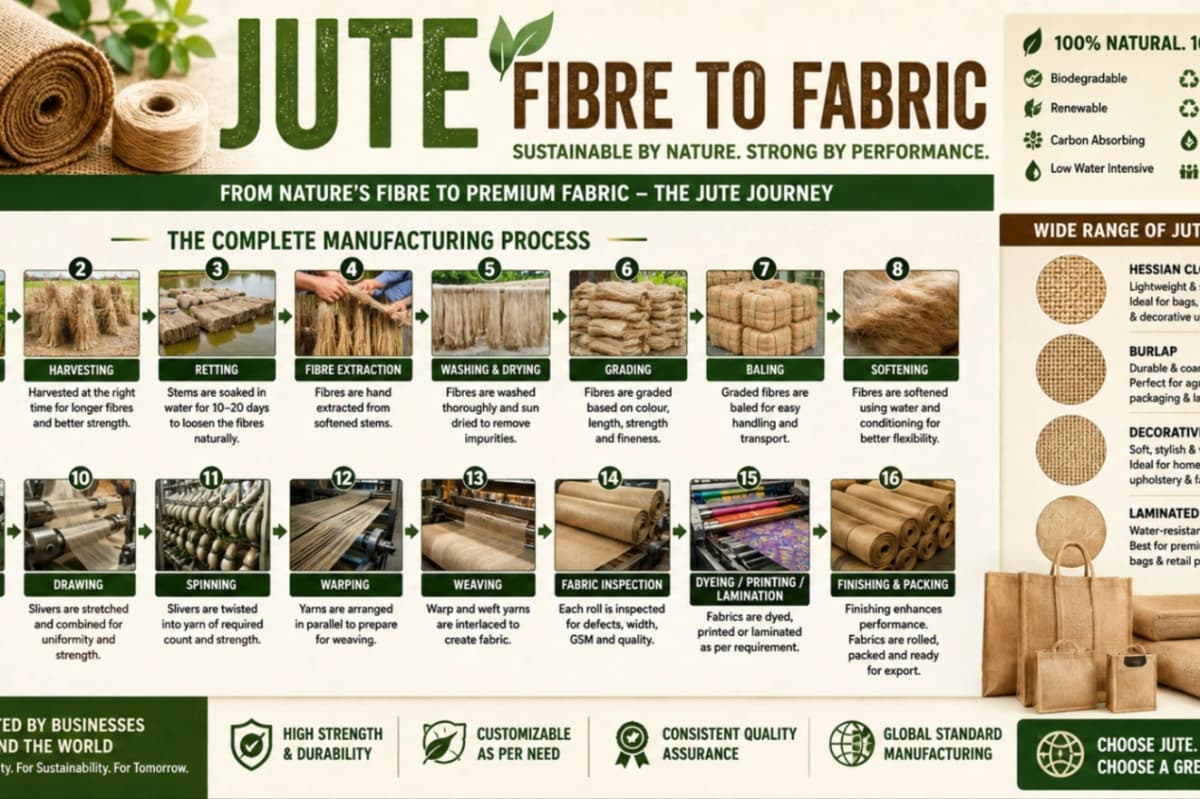
Jute Cultivation
        │
        ▼
Harvesting
        │
        ▼
Retting
        │
        ▼
Fibre Extraction
        │
        ▼
Washing & Drying
        │
        ▼
Grading
        │
        ▼
Baling
        │
        ▼
Softening
        │
        ▼
Carding
        │
        ▼
Drawing
        │
        ▼
Spinning
        │
        ▼
Warping
        │
        ▼
Weaving
        │
        ▼
Fabric Inspection
        │
        ▼
Dyeing / Printing / Laminating
        │
        ▼
Finishing
        │
        ▼
Packing & Export
Step 1: Jute CultivationThe journey begins in fertile alluvial soil with warm, humid climatic conditions.
Key Growing Conditions
- Temperature: 24–37°C
- High rainfall
- Rich alluvial soil
- Growing period: 100–120 days
Healthy cultivation produces long, uniform fibres with better strength and finer texture.
Buyer Insight:
Premium-grade fabric starts with premium-quality raw fibre.
Step 2: HarvestingJute plants are harvested once flowering begins.
Proper harvesting ensures:
- Longer fibres
- Better fibre strength
- Uniform fibre diameter
- Higher spinning quality
Delayed harvesting results in coarse fibres, while early harvesting reduces yield.
Step 3: RettingRetting is the biological process that separates fibre from the woody stem.
Bundles of jute stems are submerged in slow-moving water for approximately 10–20 days.
During retting:
- Natural microorganisms dissolve pectin.
- Fibres loosen naturally.
- Fibre quality develops.
Why Retting Matters
Good retting produces:
- Bright golden colour
- Soft texture
- High tensile strength
- Better spinning efficiency
Poor retting causes:
- Black fibre
- Weak fibre
- Uneven colour
- Processing difficulties
Workers manually strip fibres from softened stems.
The extracted fibres are:
- Long
- Flexible
- Strong
- Naturally glossy
This stage largely determines the commercial value of raw jute.
Step 5: Washing and DryingExtracted fibres are thoroughly washed to remove:
- Mud
- Bark particles
- Organic residue
- Retting impurities
The fibres are then dried under sunlight.
Proper drying prevents:
- Fungus
- Mildew
- Fibre discoloration
After drying, fibres are graded based on:
- Colour
- Length
- Fineness
- Strength
- Root content
- Defects
Common grades are selected depending on the intended application.
Higher grades are used for:
- Decorative fabrics
- Upholstery
- Premium bags
- Fashion products
Lower grades are used for:
- Sacking
- Packaging
- Industrial textiles
Graded fibres are compressed into bales for transportation.
Benefits include:
- Easier storage
- Reduced shipping costs
- Moisture protection
- Efficient mill handling
Raw jute is naturally stiff.
Before spinning, fibres are softened using:
- Water
- Softening oil emulsions
- Mechanical conditioning
Benefits include:
- Improved flexibility
- Reduced fibre breakage
- Better yarn quality
Carding aligns fibres into a continuous sliver.
This process:
- Removes entangled fibres
- Eliminates impurities
- Creates uniform fibre alignment
- Improves yarn consistency
Uniform carding leads to stronger and smoother yarn.
Step 10: DrawingMultiple slivers are combined and stretched.
Drawing improves:
- Fibre parallelization
- Weight consistency
- Yarn uniformity
- Strength
This stage significantly enhances spinning performance.
Step 11: SpinningThe drawn slivers are twisted into yarn.
Different spinning methods produce different yarn counts suitable for:
- Fine decorative fabric
- Heavy-duty sacking
- Shopping bags
- Upholstery
- Decorative textiles
Yarn quality directly affects:
- Fabric appearance
- Fabric strength
- Surface smoothness
- Durability
Warp yarns are arranged under controlled tension before weaving.
Proper warping ensures:
- Even fabric width
- Stable weaving
- Reduced yarn breakage
- Better fabric quality
Warp and weft yarns interlace to create fabric.
Common weave structures include:
Plain Weave
- Strong
- Economical
- Packaging
- Shopping bags
Twill Weave
- Softer
- Better drape
- Upholstery
- Fashion products
Herringbone
- Decorative
- Premium home furnishing
Basket Weave
- Heavy-duty industrial fabrics
Every roll is inspected for:
- Weaving defects
- Holes
- Broken yarns
- Colour variation
- Width consistency
- GSM accuracy
Professional manufacturers inspect every batch before dispatch.
Step 15: Dyeing, Printing and LaminationDepending on customer requirements, fabrics may undergo additional processing.
Dyeing
Provides:
- Corporate colours
- Fashion shades
- Decorative finishes
Printing
Suitable for:
- Brand logos
- Promotional bags
- Retail packaging
- Decorative designs
Lamination
Lamination improves:
- Water resistance
- Surface smoothness
- Print quality
- Durability
Final finishing enhances appearance and functionality.
Common finishes include:
- Calendaring
- Soft finish
- Anti-fray treatment
- Water-resistant finish
- Fire-retardant finish
- Stain-resistant coating
Finishing depends entirely on the end-use application.
Quality Parameters Buyers Should EvaluateBefore sourcing jute fabric, buyers should verify:
ParameterImportance
GSM
Fabric weight and application suitability
Width
Production compatibility
Yarn Count
Determines texture and strength
Weave Type
Impacts durability and appearance
Tensile Strength
Critical for industrial use
Moisture Content
Prevents mold during shipping
Color Consistency
Essential for branding
Fabric Finish
Determines performance characteristics
Roll Length
Affects production planning
Export Packaging
Protects fabric during transit
Common Types of Jute FabricDifferent industries require different constructions.
Hessian Cloth
- Lightweight
- Printing
- Shopping bags
- Decorative products
Burlap
- Coarse weave
- Agriculture
- Packaging
- Landscaping
CBC Fabric
- Carpet backing
- Industrial applications
Decorative Jute
- Upholstery
- Curtains
- Cushion covers
Laminated Jute
- Premium shopping bags
- Retail packaging
- Luxury branding
Understanding the manufacturing process helps buyers:
- Compare supplier capabilities
- Identify quality differences
- Negotiate better pricing
- Reduce quality complaints
- Improve product consistency
- Ensure sustainable sourcing
- Select the correct fabric specifications
Rather than purchasing solely based on price, informed buyers evaluate the complete production process to ensure long-term supply reliability.
Sustainability Advantages of Jute FabricJute continues to gain popularity because it offers significant environmental benefits.
Key advantages include:
- Renewable annual crop
- Biodegradable and compostable
- Low chemical input
- Lower carbon footprint than many synthetic fibres
- Recyclable
- Supports rural farming communities
- Suitable for circular economy initiatives
These characteristics make jute an attractive material for businesses seeking to meet sustainability goals and growing consumer demand for Eco-friendly products.
Right decision to choose Eco-friendly option:The transformation of jute from harvested fibre to finished fabric involves a series of specialized processes, each contributing to the material's final quality, durability and performance. From retting and fibre grading to spinning, weaving, finishing, and quality inspection, every stage plays a critical role in delivering fabric that meets industrial and commercial requirements.
For B2B buyers, a clear understanding of this journey provides a competitive advantage. It enables better supplier evaluation, informed purchasing decisions, and greater confidence in sourcing fabric that aligns with quality standards, sustainability objectives and end-use expectations. By partnering with manufacturers that maintain rigorous process controls and quality assurance throughout production, buyers can secure consistent, reliable jute fabrics for a wide range of applications across global markets.
admin
Providing deep insights into sustainable packaging, eco-friendly business practices and the jute manufacturing industry.